Your Recipe App Is Making You Waste $2,900 a Year
Forkee's Pantry feature turns your kitchen into the starting point, helping you cook from what you already have before you buy more.

Arsalan Ahmad
June 4, 2026
Your recipe app may be costing you more than you think.
The EPA estimates that the average family of four spends almost $3,000 per year on food that does not get eaten. More than one-third of all food produced in the United States never gets eaten, and recipe apps quietly reinforce the habit behind that waste: they train us to shop for recipes instead of cooking from what we already have.
The pattern is familiar. You find a recipe, buy a dozen ingredients, use a handful of them, and then let the rest disappear into the back of the fridge while you open the app and start the cycle again.
Chefs do the opposite
Tom Colicchio, the eight-time James Beard Award-winning chef behind Gramercy Tavern and Craft, wrote the playbook for a different way of cooking. In Think Like a Chef, he argues that good cooking does not begin with a recipe and a shopping list. It begins with what is fresh, available, and already in front of you.
Colicchio walks through the Union Square Greenmarket, picks up what looks good, and figures out the meal later. He calls it riffing: technique matters more than a fixed recipe, and the ingredient matters more than the dish you imagined before you saw what was available.
Professional kitchens work this way because it reduces waste, saves money, and produces better food. Home kitchens should be able to work this way too, but most recipe apps make it harder than it needs to be.
The app gap
Other apps gesture at this problem without quite solving it. SuperCook has a pantry feature, but it asks you to pick every ingredient from a predefined catalog of more than 2,000 items. Yummly lets you search by ingredient, but a search bar is not the same as a living pantry that remembers what you have and connects it to your own saved recipes.
The deeper issue is that many apps treat ingredients like exact database entries. Real cooks treat ingredients like flexible ideas. Chicken thighs, chicken breast, and chicken tenders are not identical, but they are close enough that an app should understand the relationship and help you make a practical decision.
Forkee starts with what you have
Forkee's Pantry feature is built around the way people actually cook at home: loosely, quickly, and with imperfect information.
Type in plain English and move on. There are no dropdowns to babysit, no categories to tap through, and no long setup flow before the feature becomes useful. Write "boneless chicken thighs," submit it, and keep going. Pantry entry should feel like jotting down what is in your kitchen, not maintaining an inventory database.
Cookability suggestions that actually make sense. Forkee scans your saved recipes and shows what you can cook now, what is nearly within reach, and what still needs a grocery run. If you have six of twenty ingredients for orange chicken, the recipe still appears with a clear breakdown so you can decide whether the missing items are worth grabbing or substituting.
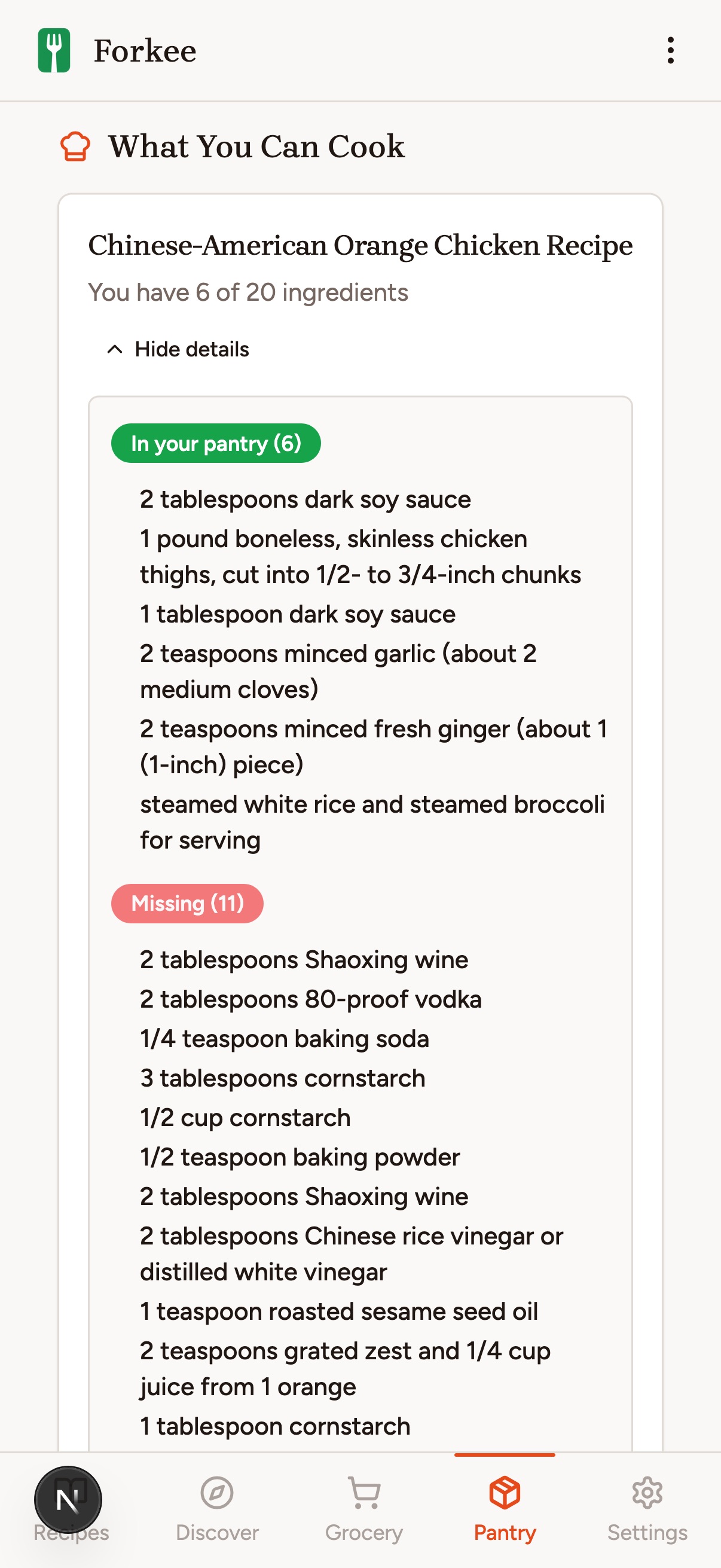
Ingredient normalization that thinks like a cook. Forkee understands that chicken thighs, chicken breast, and chicken tenders all belong to the same practical family. It knows that dark soy sauce and soy sauce overlap. This is not a demand for a perfect pantry record; it is cooking intelligence that turns a rough sense of what you have into useful recipe options.
The shift: market to meal
At home, my wife and I have been trying to make our meals healthier and more affordable without turning dinner into a planning project. Instead of choosing exact recipes before we shop, we browse the farmer's market or grocery store, pick up the vegetables, grains, and meat that look best, and decide what to cook afterward.
Once those items are in Forkee, the app helps us find recipes that use them well. That simple shift, from recipe-first planning to pantry-first cooking, saves money and reduces the mental load of figuring out what dinner should be.
The old way is to browse recipes, make a list, buy ingredients you will use once, and hope the leftovers do not go bad. The new way is to buy what is fresh, affordable, and appealing, add it to your pantry, and let Forkee show you what those ingredients can become.
That is cheaper, healthier, and less wasteful. It is also closer to the way chefs have been cooking all along.
Stop shopping for recipes
The best recipe app is not the one with the biggest recipe database. It is the one that helps you turn the food already in your kitchen into meals you actually want to cook.
Forkee's Pantry feature is live now. Open your pantry, add what you have, and see what you can make before you buy anything else.